The Death of the PSS Clinch
For nearly a decade, modern Taekwondo has been heavily defined by the "clinch" and the tight, closed-off sideways stance demanded by the Daedo and KP&P Protective Scoring Systems (PSS). In traditional combat, athletes turn their bodies almost entirely sideways, dropping their lead shoulder to physically shield their chest sensor, while using their lead leg as a defensive "cut-kick" barrier to jam incoming forward momentum.
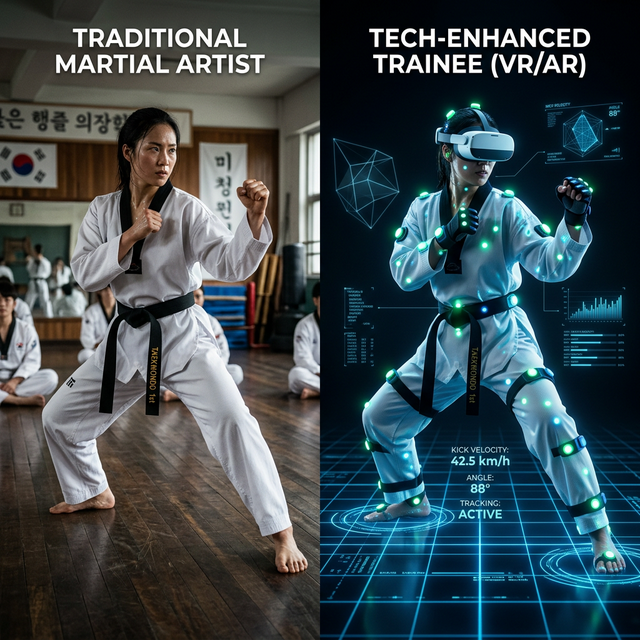
In Virtual Taekwondo, this entire meta vanishes. Because there is zero physical collision, leaning in to smother an opponent's kick is impossible. The digital hitboxes do not care if your physical arm is in the way if the opponent's kick velocity algorithm bypasses your tracking sensors. Therefore, adapting your combat stance is the first, and most critical, hurdle for transitioning athletes.
The Shift to Open, High-Mobility Stances
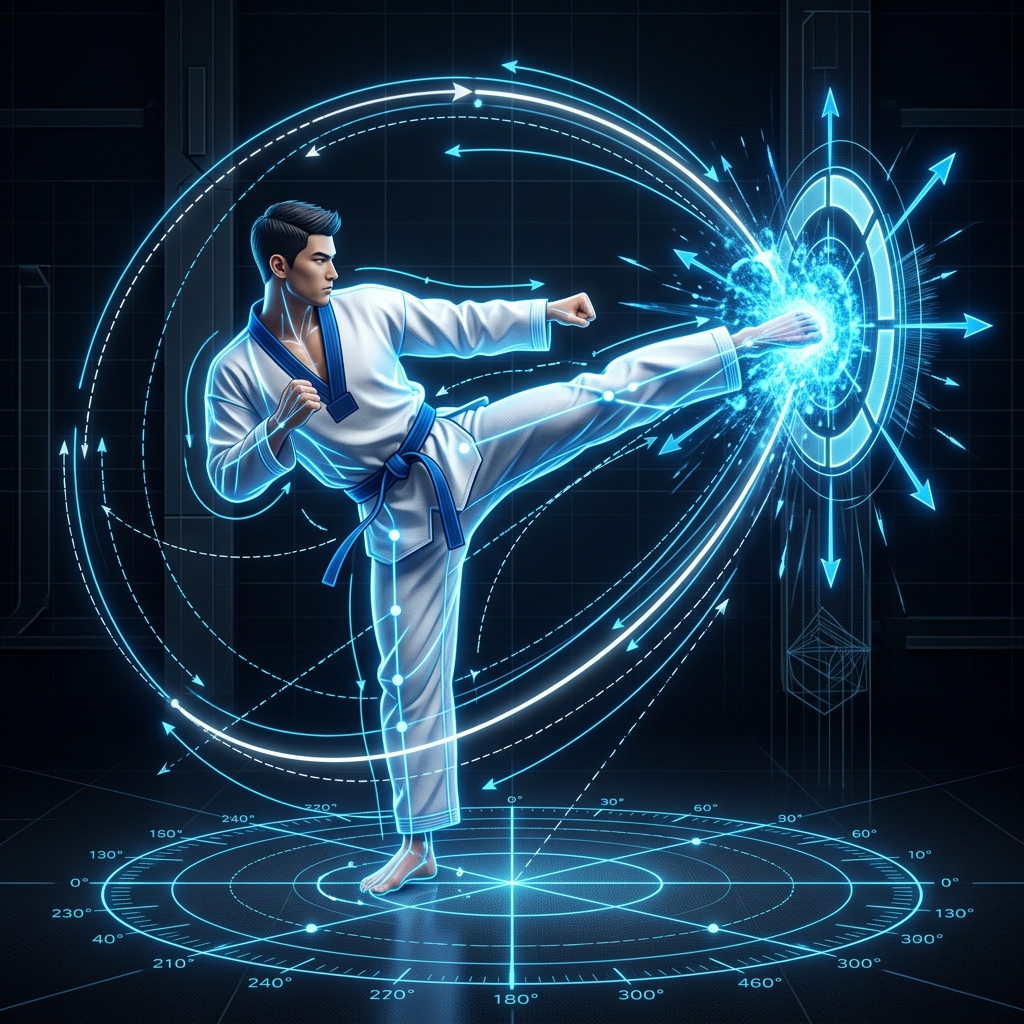
Without the fear of physical trauma or the need to "jam" physical bodies, Virtual Taekwondo heavily rewards a slightly more squared, open stance. This allows for significantly faster rotational velocity when executing spinning techniques—which inherently score massive point values in the digital engine.
The "Bouncing" Engine
In traditional sparring, heavy bouncing can be a liability as it leaves an athlete suspended in the air momentarily, vulnerable to a devastating counter-thrust. In VR combat, rapid, non-stop bouncing (the classic old-school Taekwondo step) is paramount. The digital software struggles to lock onto targets that are rapidly shifting along the Z-axis. By maintaining high-frequency vertical movement, attacking avatars create sensor "ghosting," making them incredibly difficult to hit accurately.
Re-Engineering the Front Leg
The cut-kick (a raised front leg meant to poke the chest protector) must be completely retooled. In VR, a slow push-kick will simply result in the opponent's avatar stepping completely through the attack and landing a high-velocity hook kick to the head. The front leg must transition back from a shield into a rapid-fire whip. The focus shifts entirely from "blocking" to "scoring first." The fastest signal to the tracking node wins the digital frame.
Prioritizing Flexibility and Extension
With impact trauma removed from the equation, fighters can throw head kicks with zero fear of being swept or caught and dumped onto the mat. This results in matches featuring an astronomically high volume of high kicks. Athletes who lack peak static and dynamic flexibility will be instantly routed. The stance must be low enough to spring into a high arc instantaneously.
Conclusion: A New Breed of Fighter
Coaches cannot simply place VR headsets on their elite physical fighters and expect immediate dominance. The physical rules of friction, mass, and impact have been deleted. Virtual Taekwondo requires essentially retraining the central nervous system to react exclusively to visual cues and to deploy techniques based purely on velocity and angle, unburdened by defense against physical pain.
Access Restricted to Master Tier
Detailed tactical metrics and high-level strategy are reserved for Master-class members. Unlock the full database to continue.
Tactical Debrief
Share your operational insights