The Era of Human Error
Before the 2012 London Olympics, the sport of Taekwondo was fraught with extreme, high-profile controversies regarding subjective scoring. Four human corner judges possessed the ultimate power to determine the outcome of a match based entirely on their visual perception of a strike's impact and intended target. In a sport where kicks are routinely thrown and retracted in a fraction of a second, human error—and accusations of bias—were inevitable. The sport was on the brink of losing its Olympic status entirely. It needed an objective, technological savior.
The Introduction of PSS (Protective Scoring System)
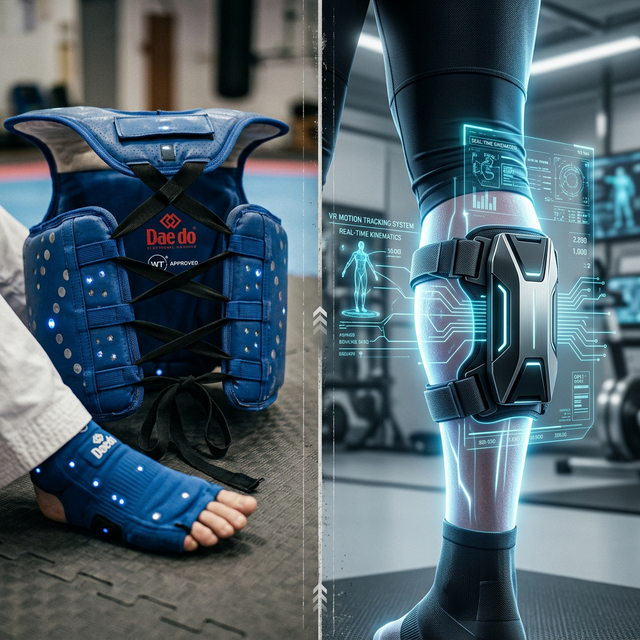
Enter the Electronic Protective Scoring System (PSS). Developed initially by companies like LaJust, and subsequently perfected by giants like Daedo and KP&P, the PSS was a revolution for World Taekwondo. The concept was simple but functionally massive: embed magnetic or pressure sensors inside the chest protector (Hogu) and headgear, matched with conductive sensing socks worn by the athletes.
If an athlete's electronic sock made contact with the opponent's body or head sensor with enough generated force (measured via an internal algorithm based on the weight division), the system would immediately send a wireless radio signal to the scorecard. Human judges were relegated specifically to scoring complex actions (like spinning kicks) and issuing penalties.
The Unintended Consequences: The Evolution of the 'Cut-Kick'
While the PSS saved Taekwondo's objective integrity, it unintentionally destroyed its stylistic identity. Athletes rapidly discovered that the PSS sensors registered light, tapping motions with the front leg exceptionally well, provided the angle was perfect.
This birthed the infamous "Cut-Kick Era." The dynamic, jumping, spinning martial art degenerated into a slow, fencing-style match where athletes stood heavily sideways, raising their front leg to "poke" the chest protector while leaning away to avoid getting poked. The power requirement was so low that true martial arts biomechanics were largely abandoned in favor of structural exploitation of the sensor placement.
The AXIS Tracking Era: Reclaiming Biomechanics
Recognizing the stagnation in standard Kyorugi viewership and the absolute failure of the PSS to reward actual athletic force without creating the cut-kick exploit, World Taekwondo sought a secondary, parallel evolution. This brings us to the present day and the integration of Virtual Taekwondo using the AXIS motion capture system built by Refract Technologies.
Why VR Tracking Solves the PSS Problem
The AXIS system works fundamentally differently than a Daedo vest. A Daedo vest only knows if "Sensor A touches Sensor B." The AXIS system knows exactly how fast the leg is rotating, the exact angle of the hips, and the terminal velocity of the foot before impact. It creates a digital hitbox.
- Velocity Gates: In VR Taekwondo, a slow, lazy front-leg "poke" will simply not register enough digital force to deplete the opponent's health bar. The system demands that the technique accurately mirrors a functional, high-speed martial arts kick.
- Full-Body Defense: In PSS, hiding the sensor saves you. In VR, the opponent can target your digital limbs, head, and torso accurately. It brings back the necessity of complex defensive weaving and true blocking, rather than just twisting the chest pad away.
Looking Forward
We are witnessing the most aggressive technological arms race in combat sports history. As the PSS generations (Generation 3 and 4) struggle to balance sensor sensitivity with physical realities, the Virtual Reality discipline provides a clean slate. It perfectly digitizes human intent without the messy constraints of physical armor exploitation.
Tactical Debrief
Share your operational insights