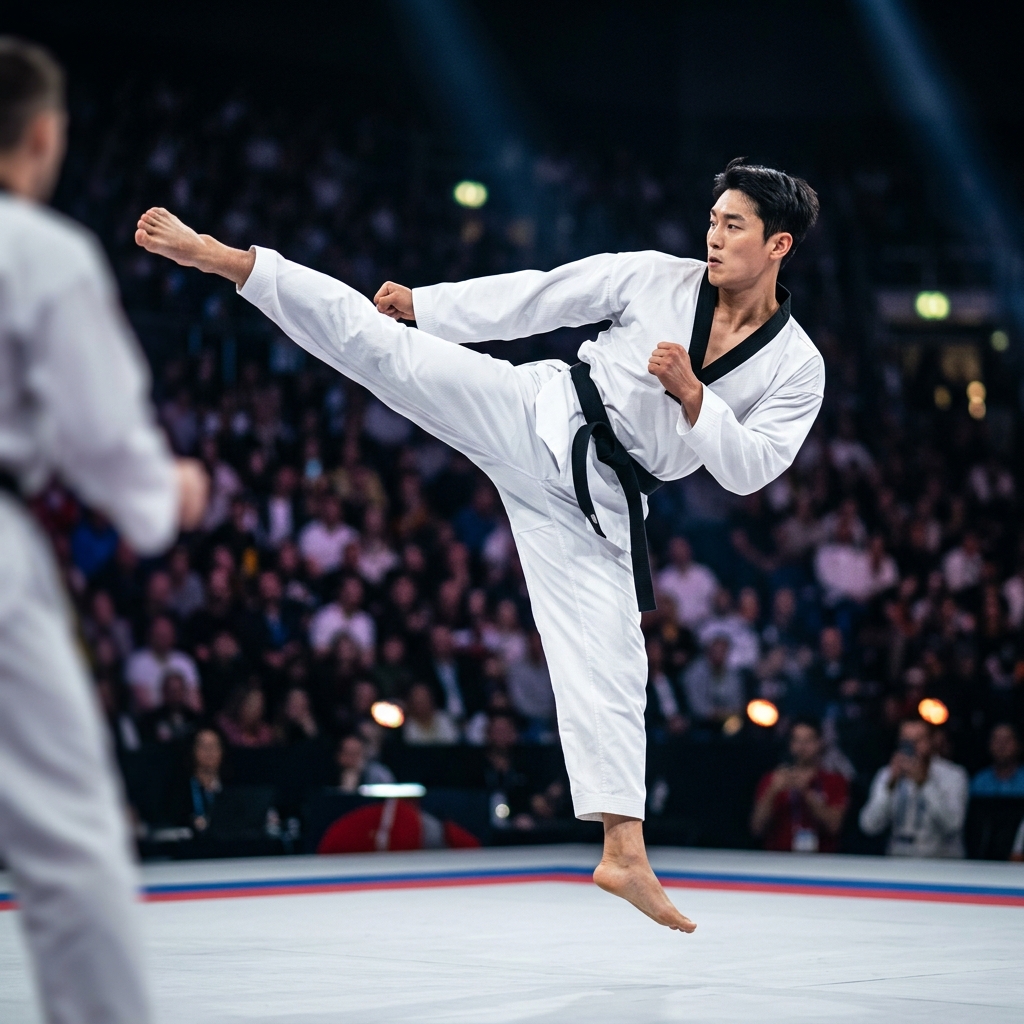
The Shift to the Octagon
For decades, Taekwondo matches took place on a traditional 8x8 meter square mat. This allowed fighters to easily backpedal straight into the corners to stall for time. To combat this defensive meta, World Taekwondo introduced the octagonal ring. Mastering Ring Management in the octagon is now a prerequisite for international success.
The octagonal shape mathematically reduces the "safe" area behind a retreating fighter. There are no deep 90-degree corners to hide in; retreating in a straight line quickly forces an athlete out of bounds, resulting in an automatic Gam-Jeom (penalty).
"The octagon does not allow for cowards. If you back up, the geometry quickly betrays you. You must fight your way out."
Tactical Geometry: Controlling the Center
The athlete who controls the center of the octagon dictates the pace of the match. This is known as the 'Bullseye Strategy.'
- The Pivot Point: By claiming the exact center, an athlete only needs to pivot a few degrees to track their opponent. Conversely, the opponent circling the perimeter must expend massive amounts of anaerobic energy to maintain lateral movement.
- The Invisible Cage: Elite fighters use "checking" motions (lifting the front leg without extending) not to strike, but to herd their opponent toward the boundary lines. Once the opponent is within one meter of the edge, the pressure forces them to either step out (a penalty) or engage in a desperate, predictable counter-attack.
- The Corner Trap: While the octagon lacks deep corners, the 135-degree vertices are still vulnerable spots. A fighter trapped in a vertex has only two lateral escape routes, both of which can be easily cut off with a sweeping roundhouse kick.

Escaping the Boundary Pressure
If you find yourself backed against the boundary line, lateral movement alone is rarely enough. The most effective escape is the Clinch and Rotate.
Instead of backing out, the athlete actively bursts forward into the attacker, initiating a clinch. During the brief 3-second window before the referee breaks the clinch, the defending athlete uses their leverage to physically rotate the opponent 180 degrees, effectively swapping positions and putting the attacker's back against the boundary line instead.
Conclusion
Ring management is an invisible chess game played with footwork. An athlete with inferior speed but superior spatial awareness will consistently defeat a faster opponent by restricting their geometric options. Master the octagon, and you dictate the fight.
Tactical Debrief
Share your operational insights