Precision Protocol: The Mechanics of Dominance
Technical precision is no longer an elective skill—it is the baseline for survival in the 2028 Olympic cycle. World Taekwondo (WT) has initiated the "Precision Protocol," a sweeping set of systemic changes that redefine how dominance is measured, rewarded, and enforced on the mat.
1. The 15-Point Gap: Eliminating the Comfort Zone
The transition from a 12-point gap to a 15-point gap is perhaps the most psychologically disruptive change in the modern era of scoring. While it seems like a minor numerical adjustment, the tactical ripple effect is profound.
Statistical Rationale: The "Comeback Curve"
Under the 12-point system, an athlete who fell behind by two head kicks and a body shot often faced a "Point Gap" termination before they could find their rhythm. Data from the 2023-2024 Grand Prix series revealed that roughly 14% of matches were ended early by 12-point gaps, frequently just as the trailing athlete initiated a high-intensity comeback sequence.
By shifting to 15 points, WT has expanded the "Contested Zone." This extra 3-point buffer allows for a full spinning head kick ($+5$) or a combination of head ($+3$) and body ($+2$) strikes to bring the match back from the brink of technical knockout. It forces the leading athlete to remain aggressive rather than playing "keep-away" to trigger a 12-point mercy rule.
2. The Geometry of the Octagon: Boundary Physics
The "Interpretation Era" of refereeing is being systematically dismantled. Historically, the boundary line was a suggestion—a grey area where referee discretion often dictated the outcome of a match. The Precision Protocol replaces discretion with Binary Enforcement.
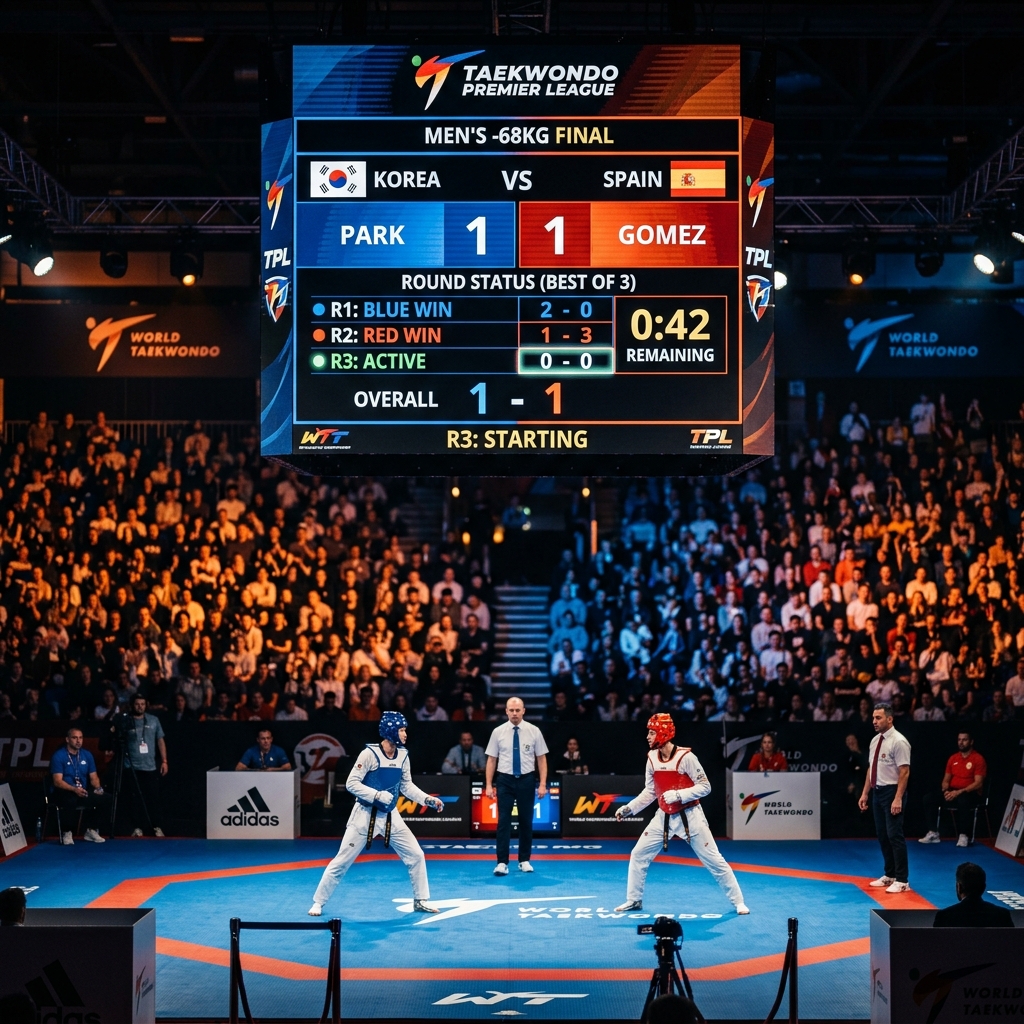
Zero-Tolerance Gam-jeom
Starting in the 2027 season, any part of the foot crossing the vertical plane of the boundary line results in an immediate Gam-jeom (Penalty). This forces a radical shift in footwork. The "Edge-Hugger" meta—where defensive specialists would circle the very periphery of the ring to bait missed strikes—is now a high-risk gamble that leads to point bleed.
Athletes must now master Center-Ring Dominance. Circular movement must be tighter, and lateral shifts must be more explosive. We are seeing the rise of "Internalized Geometry," where elite practitioners can sense the boundary line without looking, moving with a precision that keeps them exactly 15cm from the edge at all times.
3. Head Kick Valuation: PSS Recalibration
The tech stack behind the PSS (Electronic Protection & Scoring System) has undergone a fundamental core update. The focus has shifted from simple impact detection to Torque-Verified Activation.
- Spinning Head Kicks ($+5$ Points): The system now requires a measurable centrifugal force vector to trigger. This eliminates "incidental" contact scores where a foot merely grazes the helmet. You must commit to the rotation.
- Impact Thresholds: WT has unified the Newton-meter requirements across weight classes to ensure that "soft-touch" athletes are penalized by a lack of scoring. If you don't hit with technical conviction, the sensors will simply ignore the contact.
4. The "Technical Card" and the Data-Driven Appeal
To support the Precision Protocol, WT has refined the coaching appeal system. The new "Technical Card" allows coaches to challenge any scoring event or boundary call with a high-stakes twist: an unsuccessful appeal results in an immediate 2-point penalty for their athlete.
This "High-Stakes Transparency" ensures that only legitimate system failures or egregious human errors are challenged, keeping the flow of the match intact. Coaches are no longer just tactical advisors; they are data analysts who must decide if the risk of an appeal outweighs the probability of success.
5. Historical Evolution: From Subjectivity to Silicon
To understand the Precision Protocol, one must look back at the chaotic origins of Olympic Taekwondo. In Sydney 2000, judging was subjective, loud, and often controversial. A "good hit" was whatever three referees felt looked dominant. This led to a style characterized by wild, uncoordinated aggression—entertaining, but difficult to standardize globally.
The introduction of the first-generation PSS in London 2012 was a reaction to the judging scandals of Beijing 2008. While it solved the objectivity problem, it created the "Front-Leg Hook" meta—a low-tempo, fencing-style game that prioritized reach and minimal contact. The Precision Protocol is the Third Wave of Taekwondo evolution: using technology not just to count hits, but to define quality.
6. Tactical Playbook: Navigating the 15-Point Horizon
For coaches and athletes, the mission is clear: Hyper-Efficiency.
- The First-Minute Surge: Scoring early and establishing a 5-6 point lead creates immense psychological pressure under the 15-point rule. The opponent knows they are only a few mistakes away from a technical knockout.
- Boundary Baiting: Master the art of pressing an opponent toward the edge. In the new zero-tolerance environment, forcing an opponent to step out twice is functionally equivalent to scoring a body shot ($+2$).
- Multi-Plane Attacking: Because the PSS now verifies torque, attacks must be launched from multiple angles to find the gaps in the sensor coverage while maintaining the required impact force.
7. The Physiological Price: Lactic Thresholds and the 15-Point Gap
The extension of the gap from 12 to 15 points isn't just a mental challenge; it is a metabolic nightmare. In the previous 12-point era, an athlete could effectively "redline" their anaerobic system for a short burst (30-40 seconds) to secure a gap and end the round early, essentially escaping the physical toll of a full match.
Under the Precision Protocol, that burst must be sustained. Calculations by high-performance scientists indicate that the final 3 points of a 15-point gap require an additional 12-15% increase in total metabolic expenditure. Athletes who blow their "nitro" too early, failing to hit the 15-point mark, find themselves in a Metabolic Deficit during the final 30 seconds, vulnerable to a rapid counter-gap.
Lactate Management
The forced pace of the 15-point era results in higher peak lactate levels ($>12 mmol/L$). Training must transition to high-intensity interval clusters that simulate "Gap Chasing."
Neuromuscular Fatigue
As the Central Nervous System (CNS) fatigues, the torque required to trigger the new sensors becomes harder to generate. Precision drops exactly when the sensors demand it most.
8. Proprioception and the "Octagon Anchor"
Elite boundary management in the Precision Protocol era moves beyond simple visual cues. Athletes are now training with Visual Anchors—specific points in the arena (the referee's position, the scoring screen, the opponent's shadow) to triangulate their position relative to the zero-tolerance boundary.
We are seeing the integration of haptic training mats in elite performance centers. These mats vibrate when an athlete comes within 10cm of the boundary, hardwiring the "Boundary Sense" into the athlete's muscle memory. In the heat of the LA 2028 stadium, there will be no time to check the floor; the foot must know its limits instinctively.
9. Comparative Analysis: The "Fencingization" of Taekwondo
Critics of the electronic era often lament the loss of the "Heavyweight" feel of the sport, yet the Precision Protocol actually borrows heavily from the elite standards of Olympic Fencing (Epee). In Fencing, the target area is absolute and the detection is binary. By adopting this level of technical rigidity, Taekwondo is moving away from the "Brawl" and toward the "Simulated Duel."
This transition validates Taekwondo's place in the modern Olympic program. The International Olympic Committee (IOC) favors sports that are transparent, data-rich, and broadcast-friendly. The Precision Protocol provides clear "Stop-Start" metrics and high-stakes "Challenge" moments that translate perfectly to high-definition slow-motion replays and real-time biometric overlays.
10. The Youth Pipeline: Training the Unseen
For the generation currently in the cadet and junior ranks, the Precision Protocol is the only Taekwondo they will ever know. Unlike the veterans who had to "unlearn" the subjective era or the early PSS "flicks," these new athletes are being built in laboratories. Their kicks are biomechanically optimized for the torque-sensors; their footwork is natively geometric.
The "Precision Cadet" is an athlete who doesn't just kick; they calibrate. They understand the difference between a 14-Newton strike and a 16-Newton strike. This level of granular control is the hallmark of the next decade of Taekwondo. The gap between the "Club Athlete" and the "Scientific Elite" is widening, and the Precision Protocol is the wedge driving them apart.
11. The Physics of the "Cut-Kick" in the 15-Point Meta
The front-leg cut-kick (Yeop-chagi) has long been the primary weapon for distance management, but the Precision Protocol forces a tactical evolution. In the 12-point era, the cut-kick was often used as a "Shield"—a passive technique to jam the opponent's approach. With the 15-point gap and torque-verification, the "Passive Shield" is now a liability.
Athletes are now training for the "Offensive Cut." This involves a complex biomechanical sequence where the lead leg isn't just lifted; it is loaded with potential energy through a slight hip-cocking motion, then exploded into the target. The PSS sensors now differentiate between a "Slide" (where the foot pushes the protector) and a "Strike" (where the foot impacts with sufficient acceleration). Only the latter triggers the $15N$ requirement for a body score. To secure a 15-point gap, you cannot just push; you must pierce.
⚠️ Tactical Error: The "Soft Jam"
Attempting to jam a 15-point gap chaser with a soft cut-kick often results in the defender stepping back out of bounds. The resulting Gam-jeom is a $100%$ efficiency loss. The defender provides a point without the opponent even needing to land a strike.
12. Crowd Psychology: The "Gap Pressure" Effect
The psychological dimension of the 15-point gap is amplified by the live stadium environment. In a packed arena, the "Roar" of the crowd usually follows a head kick. Under the Precision Protocol, the Scoreboard Visuals are being updated to include "Gap Progress Bars."
When an athlete hits a 10-point lead, the stadium's LED surrounds will shift to a pulsing red—the "Gap Danger Zone." This creates a Pavlovian response in the crowd, whose increased volume creates a physiological stress response (increased cortisol) in the trailing athlete. Mastering the "Noise Floor" of the 15-point gap is now a core part of Olympic psychological preparation. You are not just fighting the opponent; you are fighting the building's intent to see a technical knockout.
13. Advanced PSS Debugging: The Coach's Data Stream
During the minute-break between rounds, elite coaches now have access to Haptic Heatmaps—real-time data showing where their athlete's strikes are landing relative to the sensors' optimal trigger zones. The Precision Protocol encourages this data-driven coaching.
If the athlete is landing strikes that aren't scoring, the coach can identify if it's a lack of pressure (Newtons) or a lack of torque (centrifugal force). "You're hitting the seam, not the sensor" is the new tactical instruction. This level of technical debugging allows for mid-match calibration that can be the difference between a 14-14 draw and a 15-point victory.
14. The "Final-Second" Rule: Round-Based Strategy
Because the gap rule applies to individual rounds in the "Best of Three" system, the 15-point protocol has a unique expiry. A common mistake is "Gap Chasing" with 5 seconds left on the clock. The energy expenditure required to gain 3 points in 5 seconds is massive, and if the clock runs out before the 15th point is registered, that energy is essentially wasted for the next round.
The Optimized Expiry strategy suggests that if the 15-point gap is not achieved by the 0:15 mark of the round, the leading athlete should pivot to "Energy Reservation" (ER). This conservation ensures they start the next round with a fully replenished ATP-PC system, while the opponent—who was frantically defending the gap—starts in a state of oxygen debt.
The Verdict: LA 2028 is the Era of the Elite
The Precision Protocol is a filter. It will remove the lucky, the passive, and the technically inconsistent. As we move toward Los Angeles 2028, we are witnessing the birth of a sport that is faster, more objective, and infinitely more demanding. In this stadium, the scoreboard doesn't lie, and the sensors don't forgive. This is not just a game of points anymore—it is a game of absolute precision, biomechanical mastery, and cold, calculated dominance.
Access Restricted to Master Tier
Detailed tactical metrics and high-level strategy are reserved for Master-class members. Unlock the full database to continue.
Tactical Debrief
Share your operational insights