The Paradigm Shift in Training Methodologies
For decades, standard Taekwondo training (Kyorugi) has revolved entirely around physical impact conditioning: kicking heavy bags to build bone density, utilizing paddle targets for focus, and engaging in brutal physical sparring to numb the body's pain response.
If you transition into Virtual Taekwondo utilizing these exact same training modalities, you will fail. The digital arena does not care about bone density or your ability to sustain a bruised rib. The AXIS sensor grid only measures three things: Velocity, Anatomical Angle, and Spatial Timing. Therefore, your training drills must aggressively pivot from 'impact conditioning' to 'spatial precision'.
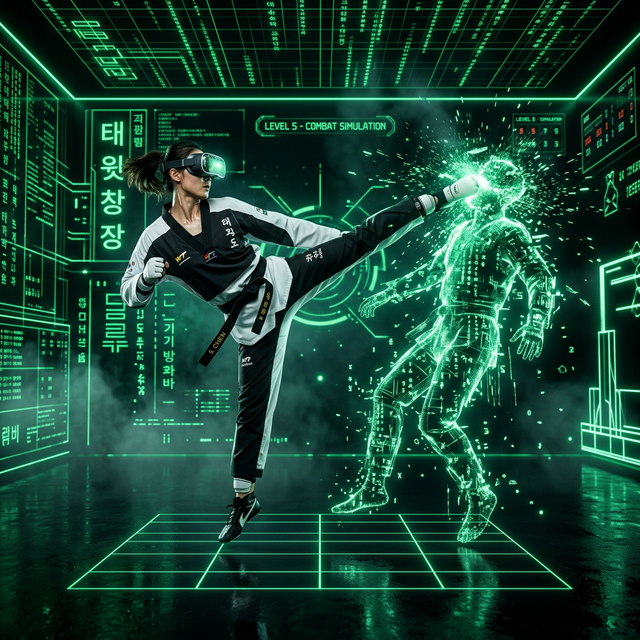
Drill 1: The Depth-Perception Shadow Box
The most difficult transition into the VR headset is trusting digital depth. Because you have no physical reference point (like feeling the opponent's leading foot against yours), you must train your stereoscopic vision to determine exactly when a digital kick will trigger a hitbox collision.
- The Setup: Wear the VR headset and load an immobile training dummy avatar. Do not wear the leg nodes yet.
- The Execution: Instead of kicking, slide-step aggressively towards the dummy. Visually hyper-focus on the EXACT centimeter where the digital avatars touch. Slide out. Repeat 100 times.
- The Goal: You must remap your brain's spatial awareness from physical proximity to digital screen proximity. If you misjudge depth by 2 inches in VR, your kick misses entirely and you leave yourself open to an instant counter.
Drill 2: Velocity-Threshold Isolation
Unlike a physical chest protector that might accidentally trigger from a slow, grinding push (a 'monkey kick'), the Virtual Taekwondo engine utilizes strict velocity gates. If a kick does not hit a predefined rotational speed, it registers zero damage.
- The Setup: Hook up the leg nodes and engage the raw diagnostic screen (which bypasses the game engine and shows raw sensor data output in km/h or m/s).
- The Execution: Execute standard roundhouse kicks into the air. Do NOT utilize a target pad. You must learn to generate maximum velocity against zero physical resistance, which is incredibly taxing on the knee and hip flexors.
- The Goal: Find the exact minimum muscular exertion required to trigger the digital 'High Impact' threshold, and memorize that feeling. In a 3-round digital match, over-kicking into empty air drains your stamina exponentially faster than kicking a physical object.
Drill 3: The Z-Axis Ghosting Bounce
A stationary target in VR is a dead target. Because there is no physical mass to stop them, opponents can unleash a flurry of six kicks in two seconds. Defense is achieved purely through erratic movement.
- The Execution: Without throwing a single kick, maintain an extremely high, erratic bounce. Shift instantly from a closed stance to an open stance. Instead of retreating linearly backward (which the software easily tracks), utilize lateral 45-degree angled steps.
- The Goal: The objective is to force the opponent's VR camera viewport to constantly re-center on your avatar, inducing digital motion sickness and cognitive fatigue in the opponent. By mastering lateral 'ghosting' movements, you drastically reduce their hitbox accuracy.
Conclusion
The masters of Virtual Taekwondo will be those who treat it exactly like what it is: a high-speed biomechanical algorithm. By removing the heavy bags and focusing on raw air-velocity and stereoscopic depth perception, modern athletes can exploit the tracking software to achieve absolute dominance in the digital octagon.
Access Restricted to Master Tier
Detailed tactical metrics and high-level strategy are reserved for Master-class members. Unlock the full database to continue.
Tactical Debrief
Share your operational insights