The Definition of an Athlete in the Digital Age
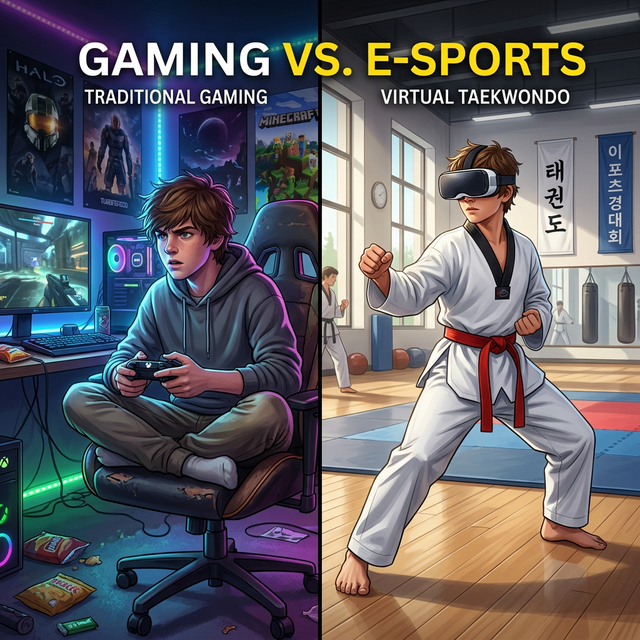
For the past two decades, a vicious semantic war has raged regarding the definition of "e-sports." Can a teenager sitting in a high-end ergonomic chair clicking a mouse at 400 Actions Per Minute (APM) truly be classified as an "athlete" on par with an Olympic swimmer or a heavyweight Kyorugi champion? Traditionalists adamantly say no, citing the lack of gross motor cardiovascular exertion.
This ideological divide has prevented organizations like the International Olympic Committee (IOC) from fully embracing massive titles like League of Legends or Counter-Strike. The arrival of Virtual Taekwondo (VTKD) obliterates this argument entirely. It is the missing link—a true hybrid that demands extreme physical athleticism to execute digital actions.
Replacing the Controller with the Human Body
In standard e-sports, the controller (keyboard, mouse, gamepad) acts as a physical bottleneck. The limiting factor is finger dexterity and thumb speed. In Virtual Taekwondo, utilizing the AXIS motion capture system, the controller is the athlete's entire biomechanical structure.
To throw a high kick in a traditional fighting game, the player presses the 'Triangle' button. To throw a high kick in VTKD, the athlete must genuinely recruit their glutes, pivot their supporting foot, snap their hips, and throw their physical leg into the air at high velocities. The digital avatar's success is absolutely 1-to-1 tethered to the physical power, flexibility, and lactic-acid endurance of the human pilot.
The Ultimate Broadcast Product
Why is this the future? Because it appeals to two massively lucrative, yet mutually exclusive, demographics.
- The E-Sports Native: Younger audiences demand gamification. They want health bars, critical hit metrics, digital arenas, immediate statistical feedback, and spectacular, physics-defying digital graphics. VTKD delivers this perfectly.
- The Traditional Sports Purist: Older demographics demand physical sacrifice, sweat, obvious cardiovascular strain, and the mastery of human physical potential. Because VTKD athletes are executing real martial arts maneuvers, exhaustion and physical brilliance are constantly on display.
Solving the Spectator Confusion Problem
A frequent criticism of modern Olympic Taekwondo is that to the untrained eye, the electronic PSS scoring is confusing. A light tap registers a point, while a crashing blow sometimes misses the sensor. The subtleties of the clinch are hard to market to casual audiences.
Virtual Taekwondo operates on video game logic, which is universally understood by the entire global population under the age of 40. When a digital foot violently connects with a digital head, an explosion of pixels erupts, the damage number floats into the air, and the opponent's health bar noticeably depletes. It translates complex martial arts scoring into a purely digestible, hyper-entertaining visual language.
The Road to Global Domination
With its inclusion in the 2027 SEA Games, VTKD is moving out of the exhibition halls and into the global sporting consciousness. It represents the first iteration of "Active VR E-Sports" to be taken completely seriously by a major governing body (World Taekwondo).
As the tracking technology inevitably becomes cheaper and more mobile, we will see a paradigm shift in martial arts gyms globally. The dojang of 2030 will feature heavy bags alongside VR tracking mats, training a new breed of warrior: the true cyber-athlete, whose physical prowess is perfectly mirrored in the digital realm.
Tactical Debrief
Share your operational insights