The Physics of Destruction
In modern World Taekwondo (Kyorugi), the back kick (Dwi Chagi) and the spinning hook kick (Dwi Huryeo Chagi) are not just spectacular aesthetic techniques—they are statistical necessities. Due to the Protective Scoring System (PSS) mechanics, specialized spinning techniques applied to the head or torso are rewarded with heavily multiplied point values (up to 5 points depending on the era and rule set). However, because they expose the athlete's back momentarily, they carry immense risk. Therefore, execution must be biomechanically flawless.
Stage 1: The Base Rotation and Angular Momentum
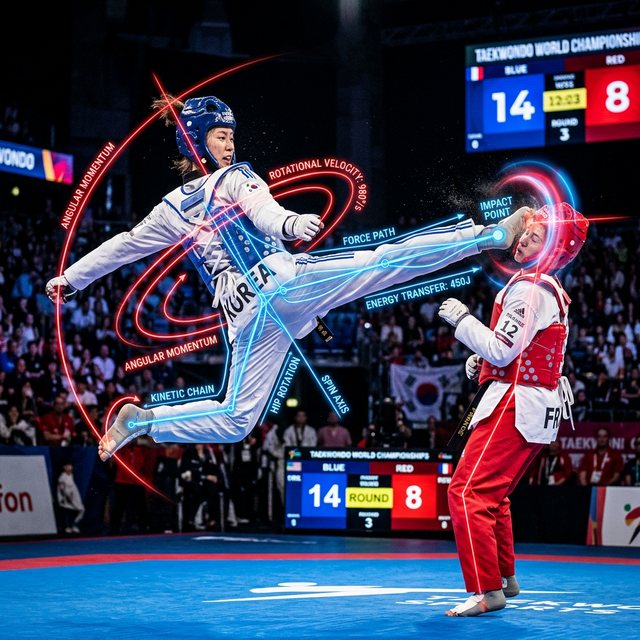
A fatal error made by junior athletes is attempting to generate power from the kicking leg itself. In true high-performance kinematics, the kicking leg is merely the 'whip'; the power is generated entirely by the supporting leg and the hips. The movement begins with the front foot pivoting sharply (180 degrees) while the lead shoulder aggressively drops and rotates backward.
This creates a massive kinetic coil. The upper body rotates faster than the lower body, building torque in the core musculature. This is known as angular momentum conservation. By keeping the arms tucked tightly to the chest during this phase, the athlete reduces their moment of inertia, dramatically increasing their rotational speed—exactly like a figure skater pulling in their arms during a spin.
Stage 2: The Chamber and Sighting
As the body spins to expose the back, the athlete must complete the 'chamber'. The kicking knee must be driven straight backward, tightly compressed against the glute. Simultaneously, the head must snap around faster than the torso. The athlete's eyes must acquire the target (the opponent's Hogu or headgear) a fraction of a second before the leg extends.
Firing a blind spinning kick against elite counter-fighters guarantees you will be hit with an immediate roundhouse to the open spine or back of the head. Sighting allows the athlete to micro-adjust the trajectory based on the opponent's evasive movement during the spin.
Stage 3: The Extension and Kinetic Release
Upon acquiring the target, the kinetic energy stored in the twisted core is violently released. For a back kick (Dwi Chagi), the heel is driven in a linear, piston-like strike directly backward. The foot must be flexed (toes pointing toward the ground) to expose the calcaneus bone, creating maximum pressure per square inch to guarantee the PSS sensor triggers.
For a spinning hook kick, the leg extends outward and then whips across the target in an arc, utilizing the flat of the heel or the sole of the foot. In both instances, upon impact, the athlete's supporting foot must maintain structural grounding; if the base foot lifts off the mat during impact, the Newton-force transfer drops by over 40%, often failing to register a point on electronic armor.
Conclusion: Drilling for Perfection
To master these mechanics, coaches must utilize resistance bands strapped to the athlete's hips during bag work to overload the rotational phase. The spin kick is arguably the most devastating weapon in a Taekwondo practitioner's arsenal, but it is entirely a product of physics, not luck.
Access Restricted to Master Tier
Detailed tactical metrics and high-level strategy are reserved for Master-class members. Unlock the full database to continue.
Tactical Debrief
Share your operational insights