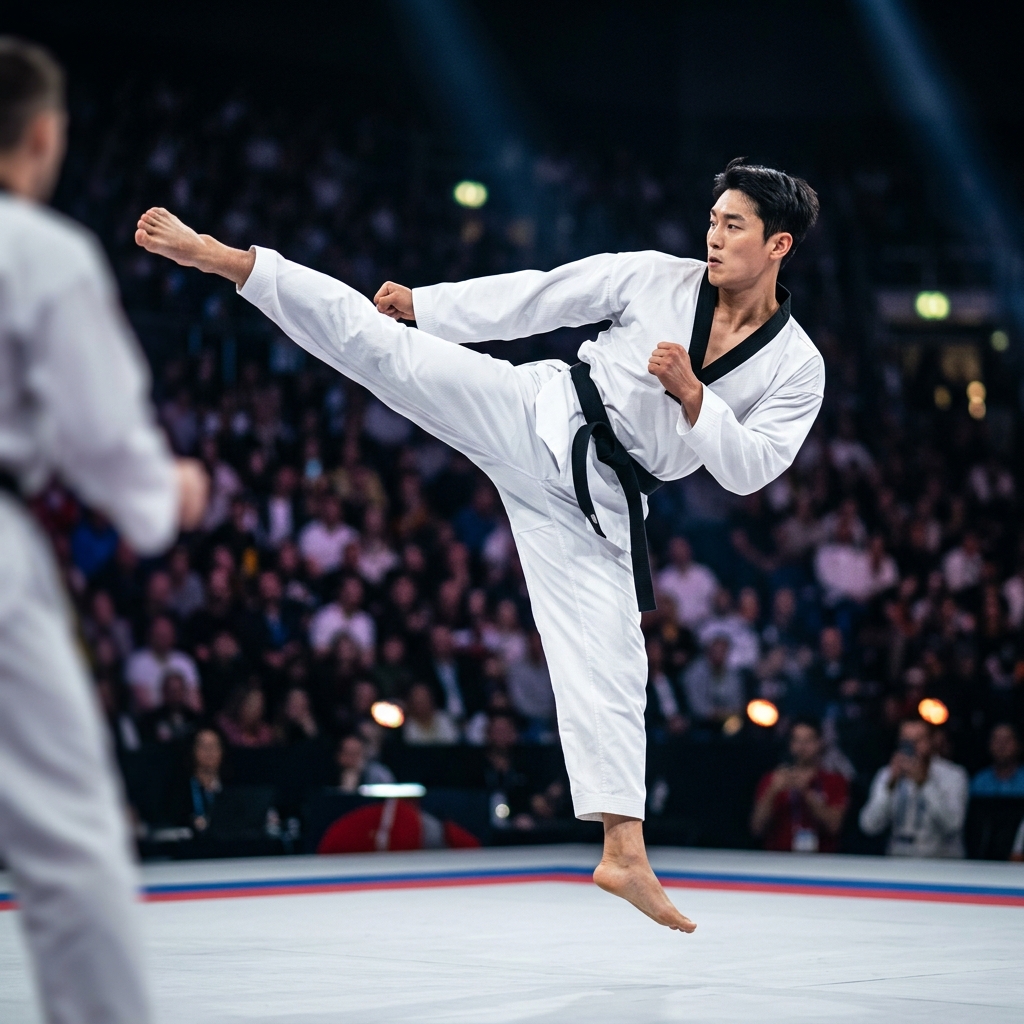
The Mathematics of the Modern Match
If you look at historical footage of Taekwondo matches from the early 2000s, turning and spinning kicks were rare, high-risk maneuvers deployed only out of desperation or extreme confidence. Today, the Spin Kick Revolution is in full effect. A competitor unable to execute a flawless, high-speed turning hook kick (Dwi Huryeo Chagi) or back kick (Dwit Chagi) is mathematically outgunned.
Why? The answer is not a sudden evolutionary leap in athletic flexibility. The answer lies purely in the World Taekwondo ruleset and the tactical meta it engineered.
"The 4-point and 5-point multiplier for spinning techniques is the ultimate trump card. A fighter can be dominated for an entire round, land one spinning head kick, and erase a 5-point deficit instantly."
The Risk/Reward Imbalance
Previously, a body kick awarded 1 point and a jump-spin kick awarded arguably 2. The risk of exposing one's back was astronomical. Today's point structure is exponentially weighted:
- Body Strike (Linear): 2 points.
- Body Strike (Spinning/Turning): 4 points.
- Head Strike (Linear): 3 points.
- Head Strike (Spinning/Turning): 5 points.
This 150% multiplier on spinning head strikes dictates the modern curriculum. Athletes spend thousands of hours drilling the rotational mechanics of 360-degree kicks because the statistical payout is simply too massive to ignore. The risk of slipping or missing is dwarfed by the potential to instantly win a round.

Setting the Trap for the Spin
Because the spin is so deadly, elite athletes dedicate the first minute of a round purely to "setting the trap". They will throw linear cut kicks repeatedly, baiting the opponent to push forward aggressively. As soon as the opponent commits their kinetic momentum forward, the athlete spins inside the critical distance.
Furthermore, the PSS (Protective Scoring System) sensors natively reward the heavy, blunt-force impact generated by centrifugal force. A grazing spinning back kick will often register higher telemetry data than a clean, linear roundhouse.
Conclusion
The Spin Kick Revolution is here to stay. It makes for spectacular television, validating Taekwondo's status as a premier Olympic sport. To survive in this meta, traditional front-leg fencers must evolve their core rotation and blind-spot awareness, or risk being mathematically erased in the final 10 seconds of a round.
Access Restricted to Master Tier
Detailed tactical metrics and high-level strategy are reserved for Master-class members. Unlock the full database to continue.
Tactical Debrief
Share your operational insights