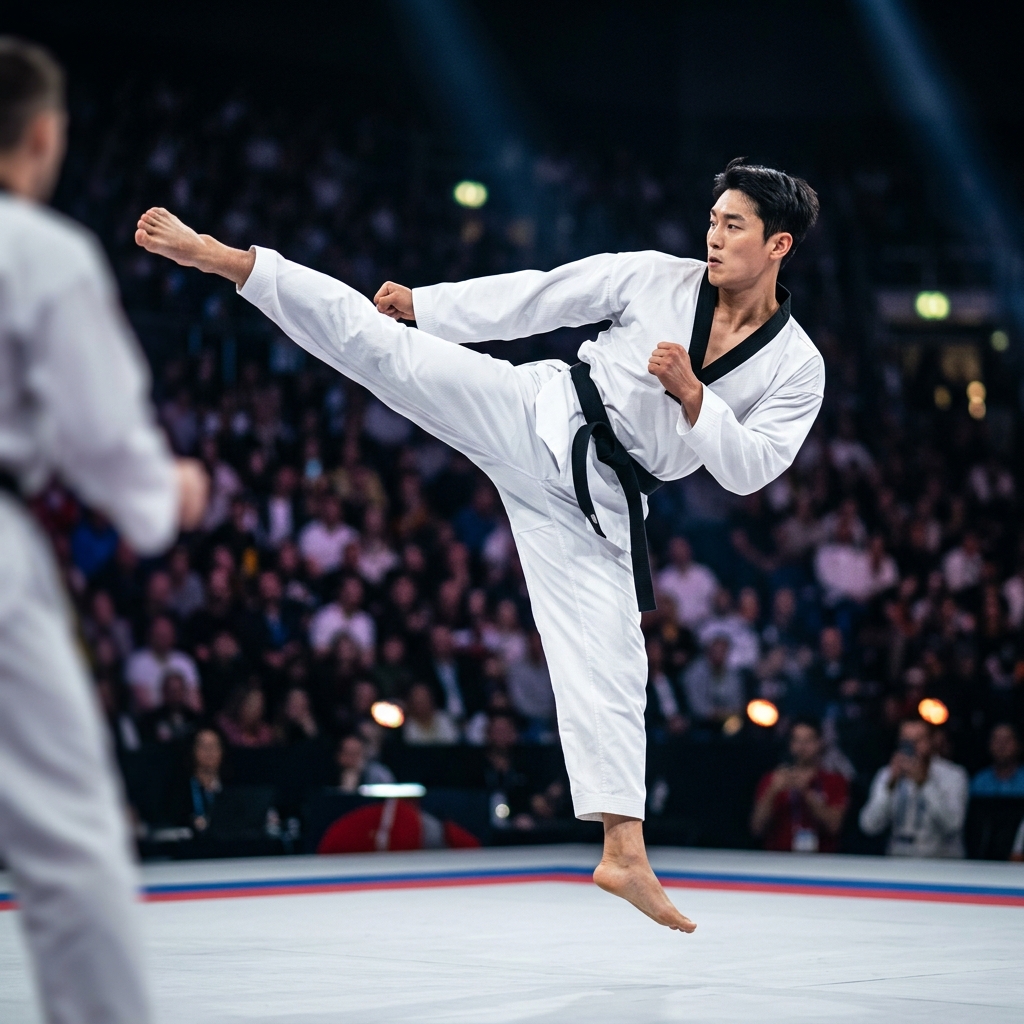
The Illusion of One Body
Team Poomsae (typically consisting of 3 members) is visually hypnotic. When executed perfectly, three individuals merge into a single, terrifyingly precise machine. However, achieving absolute Synchronization is far more complex than simply practicing the pattern together. It requires overcoming minute differences in limb length, muscle twitch speed, and fast-twitch fiber ratios.
"If I close my eyes during a Team Poomsae performance, I should only hear one footstep and one Dobok snap. If I hear two, you have failed."
Overcoming Anthropometric Differences
Rarely does a coach find three athletes with the exact same height, leg length, and wingspan. Therefore, synchronization requires deliberate structural modifications.
- The Stance Standardizer: A taller athlete will naturally have a longer Ap-Kubi (Forward Stance). To synchronize, the team must calculate a unified stance length based on the shortest member of the team. The taller athletes must consciously shorten and widen their stances to match the exact floor footprint.
- Trajectory Syncing: A high kick (Olgul Chagi) for a 160cm athlete is much lower in absolute space than for a 180cm athlete. In Team Poomsae, the target height must be standardized relative to the individual's own body (e.g., "exactly philtrum height"), requiring the taller athlete to lower their target visually to maintain a parallel line with their shorter teammates.

The 'Blind' Breathing Drill
Visual cues are actually too slow for absolute synchronization; there is an inherent processing lag. Elite teams rely on auditory and breathing cues.
Korean national teams utilize the 'Blind Drill'. The three members stand in formation and are blindfolded. They must execute an entire pattern (like Sipjin) relying entirely on the sound of the center athlete's breathing. The sharp inhale signals the chamber; the forceful exhale dictates the speed of the strike. If the team can finish the pattern blindfolded and end up on the exact same starting mark simultaneously, they have achieved true synchronization.
Conclusion
Team Poomsae is the ultimate exercise in ego suppression. An athlete cannot show off their personal explosive speed if it means finishing a punch 0.1 seconds before their teammates. The science of synchronization demands that three independent martial artists sacrifice their individuality to create a flawless, unified entity.
Tactical Debrief
Share your operational insights