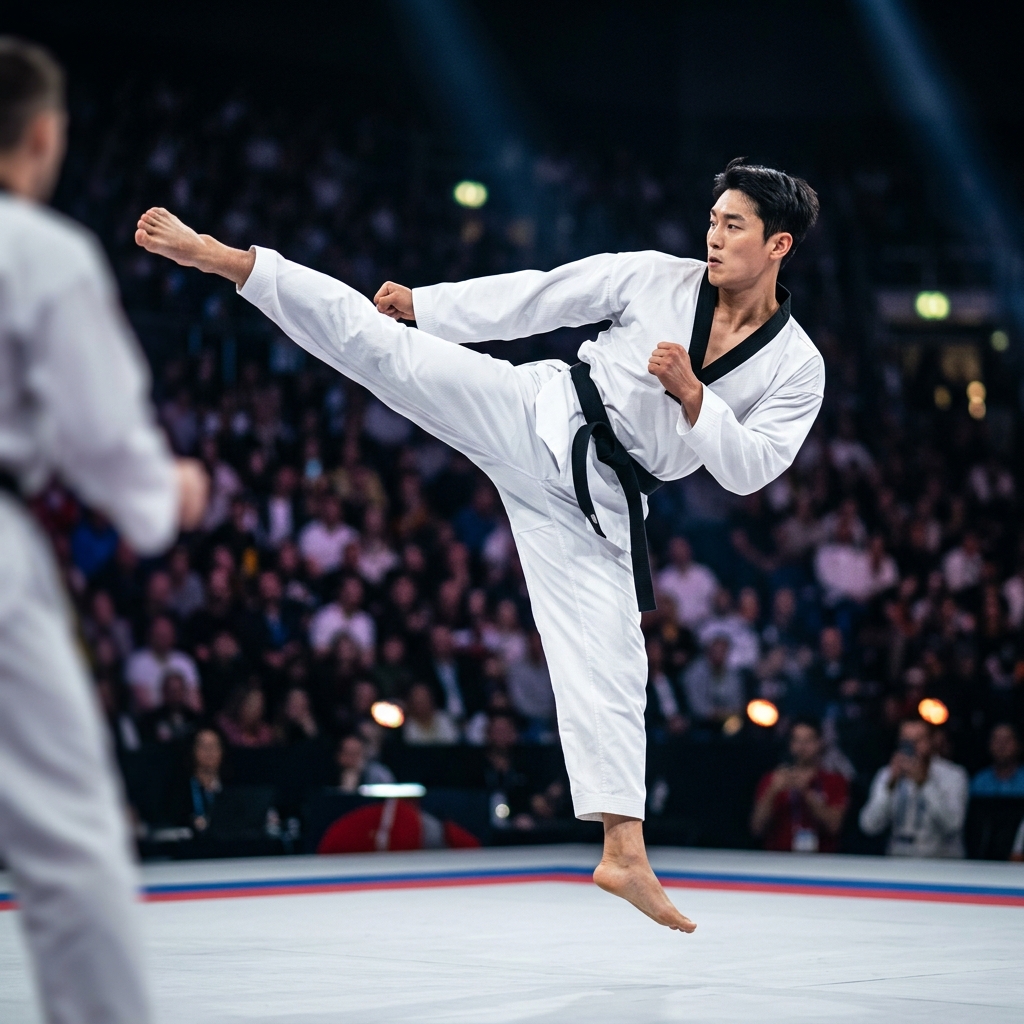
1. Executive Summary: The Dawn of Continuous Combat
The implementation of the 10-Second Passivity Protocol represents a fundamental, systemic paradigm shift within World Taekwondo (WT). This change is not merely a punitive measure; it is a strategic mandate designed to elevate the combat intensity, forcing a continuous state of high-octane, reactive engagement from the first whistle to the final second.
For decades, the sport has been subtly undermined by cyclical patterns of tactical withdrawal, indecision, and systemic "freezing" within the bout's critical closing seconds. These moments allowed skilled athletes to negate superior technical ability through minimal kinetic expenditure, transforming highly athletic exchanges into protracted, low-tempo psychological battles. The 10-Second Protocol eliminates this option.
Core Strategic Imperatives:
- Elimination of the Plateau: The ability for an athlete to safely "dial back" the intensity, especially when trailing or leading, is functionally neutralized.
- Mandate for Proactivity: The athlete must maintain a demonstrable, proactive intention to initiate offensive action or force a decisive defensive counter.
- Increased Expected Value (EV): Every second of the bout now carries an increased EV for scoring due to the $+2$ points penalty mechanic.
2. Geopolitical & Institutional Context (The Uzbekistan Mandate)
The directive emanating from the World Taekwondo General Assembly in Uzbekistan signals more than just a rule change; it reflects a necessary institutional reclamation of the sport's competitive integrity. The WT governing body, facing criticisms regarding the unpredictable variance in match intensity, has sought to re-establish a global standard of peak performance.
Historically, the enforcement of passivity has been subjective, leaving the outcome susceptible to referee interpretation. The introduction of the quantifiable 10-Second Protocol provides a standardized, binary measure of systemic inactivity. This greatly mitigates the subjective element and grounds the enforcement in measurable physical and strategic failure.
"Strategic Insight: The rule structure itself is a deterrent. It forces athletes to understand that tactical caution, when perceived as non-engagement, is mathematically penalized."
3. The Mechanics of the 10-Second Protocol (Deep Dive)
The rule hinges on identifying three primary vectors of inactivity, which the refereeing panel is now empowered to recognize and penalize during the critical final 10 seconds of any round:
- Stepping Out (Lateral Drift): Repeated, patternless lateral movement that lacks offensive utility.
- Intentional Falling/Dodge-Out: Controlled, non-reactive evasion designed to waste time and reset the kinetic state.
- Turning Back (Retreat Vector): Exiting the central combat zone and adopting a posture oriented away from the opponent.
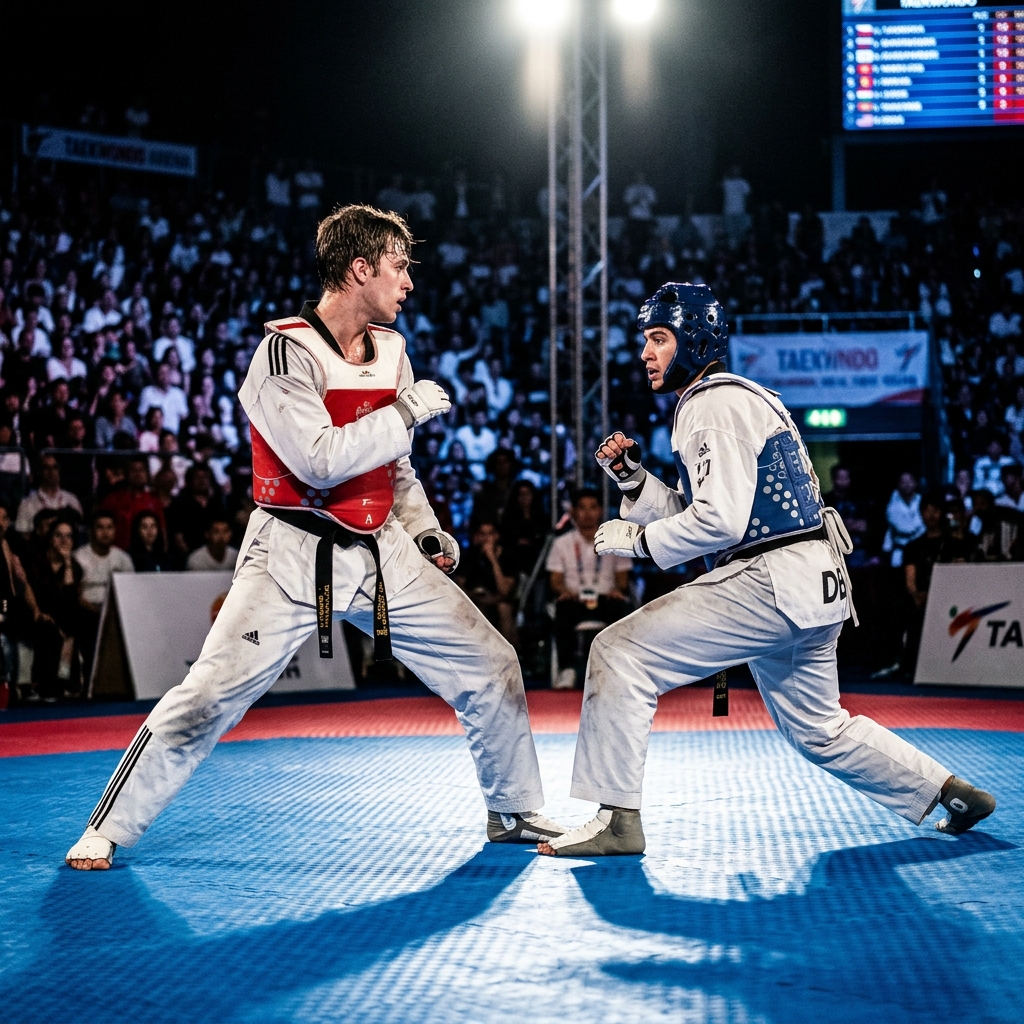
The Penalty Calculus: Double Impact (Gam-jeom = +2 Points)
The awarding of $+2$ points is strategically disruptive. It represents an overwhelming incentive to stay engaged. A standard point is merely a successful impact; a double impact point forces the athlete to immediately recalibrate their entire game plan, as it provides a significant, measurable advantage that must be accounted for.
4. Theoretical Game Theory: The End of the Defensive Shell
From a game theory perspective, Taekwondo combat was previously modeled as a mixed-motive game, allowing for cyclical deviations from the Nash Equilibrium—the state of mutual, sustained, highly kinetic engagement. The 10-Second Protocol structurally shifts the utility function of the game, rendering the previous equilibrium unstable.
In the pre-rule environment, the cost function of engaging in high-tempo exchanges sometimes outweighed the marginal reward. The new protocol increases the penalty (the negative utility) for this avoidance behavior to an extreme degree. Thus, the optimal strategy function shifts toward maximization of active engagement, even at a measurable metabolic cost.
5. Biomechanical & Physiological Toll
The primary physiological risk associated with the 10-Second Protocol is the systemic overload resulting from forced, sustained high-intensity effort. Athletes must now maintain a near-maximal anaerobic contribution for extended periods. The focus must shift from the peak power output of a single combination to the ability to maintain high kinetic output while fatigued.
Endurance training must incorporate scenario simulations that replicate the acute metabolic stress of the final minute. This requires periodization models that specifically overload the lactate tolerance threshold, rather than merely focusing on pure muscular strength or explosive speed.
6. Coaches' Playbook: New Drills for the Final 10
Training methodologies must evolve from reactive sparring to orchestrated, controlled desperation. The goal of any drill is to simulate the pressure cooker environment of the final moments.
Phase I: The Controlled Collapse
Implement a 10-round simulation bout where the last two rounds are designated "Penalty Rounds." Athletes must execute full-power, complex combination drills regardless of opponent engagement, forcing a continuous kinetic output to demonstrate non-passivity.
Phase II: Calculated Aggression
Coach dictates a score differential (e.g., -2 points). The athlete's objective is solely to force a technical error from the opponent, thereby achieving a $+2$ point gain, rather than merely scoring point-for-point.
7. The LA 2028 Outlook: Olympic Meta Predictions
The convergence of a global Olympics with the structural mandate of the 10-Second Protocol creates a novel athletic meta. We predict that the successful combatants will be those who are psychologically resilient and aerobically sustainable.
Prediction: The Rise of the Hybrid Striker. The traditional specialization will erode. The need for continuous scoring demands a fighter capable of transitioning seamlessly between high-volume, low-power attacks and explosive, high-power strikes.
Prediction: The Third Round Statistical Significance. Historically, pressure mounts exponentially as the contest progresses. We predict that the 3rd and 5th rounds will exhibit disproportionate levels of continuous, high-output offensive exchange, far exceeding previous standards.
8. Historical Context: The Evolution of Defensive Meta (2000-2024)
To truly grasp the revolutionary implications of the planned changes for LA 2028, one must meticulously trace the evolution of the sport’s tactical environment over the past quarter-century. The history of modern Olympic taekwondo is not merely a sequence of rule updates; it is a complex narrative of escalating technological mediation clashing with the inherent fluidity of human athleticism.
The foundational era, exemplified by the Sydney 2000 Games, represents a period where the defensive meta retained significant components of kinetic unpredictability. Judging relied heavily on visible impact, requiring the athlete to constantly manage distance and exploit momentary gaps in guard patterns. The successful practitioner of this era was a master of calculated aggression, using positional striking to tax the opponent’s stamina and forcing suboptimal responses.
The subsequent introduction of electronic scoring technology, cemented in pivotal events like London, Rio, and Tokyo, fundamentally shifted the paradigm. This transition mandated a tactical pivot toward point maximization and predictable targets. The focus narrowed sharply from comprehensive body coverage to precise, measurable strikes—a 'systemization' of violence. While this modernization enhanced safety and objectivity, it inadvertently created a defensive meta that was hyper-focused on the measurable kill zone.
The planned adjustments slated for LA 2028 are therefore not merely changes; they are a decisive, potentially disruptive attempt to recalibrate the system, pushing back against the hyper-optimization that has defined the sport’s most recent two decades. They signal an urgent demand for a tactical philosophy that can synthesize the aggressive flair of the early 2000s with the modern computational necessity for measurable impact.
Projected Impact Matrix: Weight Class Adaptation
The changes anticipated for LA 2028 will not affect all weight classes uniformly. The impact will be differential and highly strategic.
- Heavyweights: Fundamental challenge to core strength advantage. If the new rules increase the importance of dynamic movement over raw power striking, heavyweights must de-emphasize brute force clinch entries and refine footwork to maintain distance integrity.
- Lightweights: Poised to gain the most immediate tactical advantage. Their natural agility will be elevated to paramount importance. The new system demands superior transitions between striking and evasive footwork.
🎓 Summary of Strategic Implications
The shift from a focus on pure striking power to sustained, intelligent aggression is the single most important tactical realization of the LA 2028 cycle. The game is now being won by the athlete who best manages their cardiovascular output while maintaining a perception of perpetual threat. Passivity is no longer a strategic retreat; it is a direct pathway to failure.
Access Restricted to Master Tier
Detailed tactical metrics and high-level strategy are reserved for Master-class members. Unlock the full database to continue.
Tactical Debrief
Share your operational insights