The Stigma of the Clinch
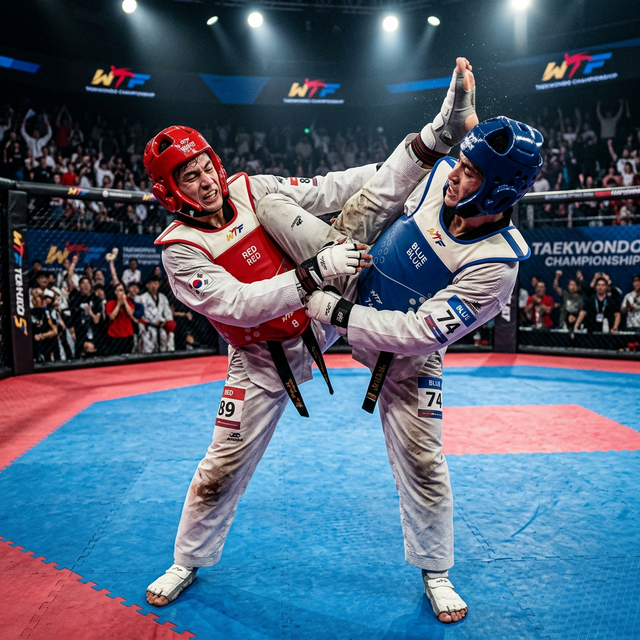
Historically, the clinch (when both athletes close the distance completely, locking their bodies together) was viewed as a failure of action. Fighters would crash together, hug awkwardly, and simply wait for the referee to yell "Kal-yeo!" (Break). It was an aggressive stalling tactic used to burn time on the clock or recover stamina.
However, World Taekwondo implemented significant rule changes regarding grabbing and pushing to force athletes to fight their way out of the clinch. Today, a fighter who simply hugs to stall will be immediately penalized. You must either separate actively or engage in one of the most mechanically demanding forms of striking: the inside game.
The Biomechanical Geometry of Inside Kicking
Throwing a kick when your opponent is pressed against your chest defies all standard Taekwondo mechanics. You cannot extend your leg, you cannot rotate your hips fully, and you cannot build momentum. The inside game relies entirely on raw flexibility and joint manipulation.
1. The Crescent 'Flick' (Naeryeo / An Chagi variations)
This is the most common and devastating clinch technique. While locked chest-to-chest, the offensive athlete slides their outer leg backward slightly to create space. Without disengaging the upper body leverage, they lift their knee violently straight up the opponent's side, turning their hip over at the final micro-second. The foot sweeps inward (like a crescent) to strike the back or side of the opponent's electronic headgear. Because head kicks are worth 3 points, this close-range gamble is incredibly lucrative.
2. The Legal 'Push-and-Pop'
Under current rules, you are allowed to execute a quick frame or push against your opponent's body using an open hand or forearm, provided it is immediately followed by a kick. (Prolonged grabbing or hauling the opponent around the mat yields a Gam-jeom). The athletic tactic is to maintain the tight clinch until the opponent slightly shifts their weight to strike. In that moment of imbalance, the fighter violently pushes the opponent backward with their arms, instantly creating exactly two feet of space—perfect firing range for a fast snap front kick or roundhouse to the chest.
Defending the Clinch
If you are taller than your opponent, they will mathematically dominate you in the clinch because their legs have less distance to travel upwards to reach your headgear. The absolute golden rule of defending the inside game is Controlling the Hips.
When an opponent attempts to lift their leg for a short-range head kick, their hip must pop upward. An elite defensive fighter will press their own hips aggressively into the opponent's launching hip, smothering the leg before the knee can even chamber. By structurally framing inward, you deny the opponent the physical space required to lift their leg.
Conclusion
The days of 'hug and wait' are over. Modern Taekwondo requires an athlete to be as deadly from zero inches away as they are from six feet away. The clinch has evolved into a violent, high-speed grappler's nightmare where flexibility and dirty-boxing tactics dictate the scoreboard.
Access Restricted to Master Tier
Detailed tactical metrics and high-level strategy are reserved for Master-class members. Unlock the full database to continue.
Tactical Debrief
Share your operational insights