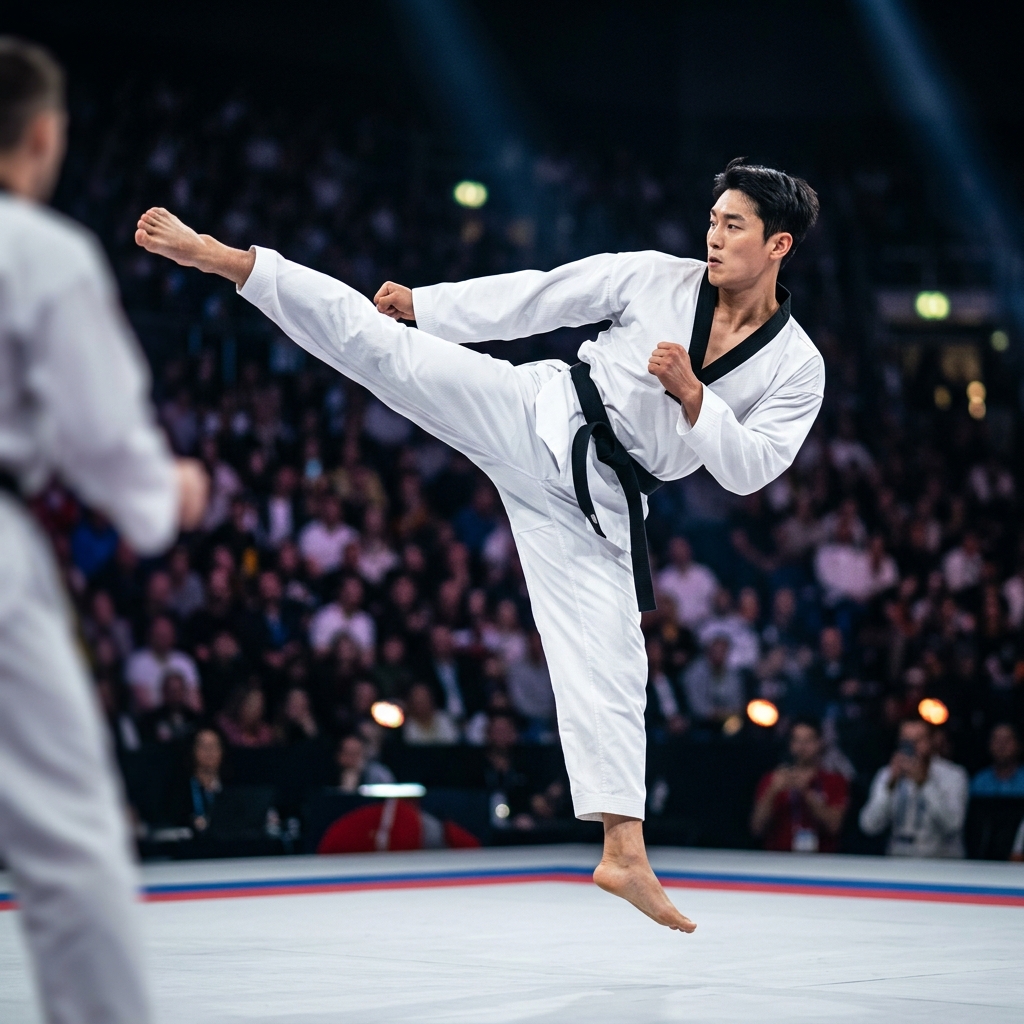
The Invisible Battleground
At the cadet and junior levels, matches are frequently determined by who kicks faster or harder. However, at the elite Grand Prix level and the Olympics, physical attributes are relatively identical. The true differentiator is entirely invisible: Distance Management.
Understanding and manipulating the exact spatial distance between you and your opponent dictates whether your kicks land cleanly, whether you invite a clash, or whether you successfully draw the opponent into a trap. This is significantly compounded by the shift from the traditional square mat to the modern octagonal fighting area.
The Three Zones of Engagement
Elite fighters mentally compartmentalize the space between them and their opponent into three distinct zones:
- Zone 1 (The Green Zone / Outside Range): Both fighters are outside kicking distance. This is the observation zone. Here, athletes utilize probing footwork ('bouncing' and 'slide stepping') to test the opponent's twitch reactions and determine their preferred lead leg.
- Zone 2 (The Red Zone / Striking Range): The critical threshold. Entering this zone means someone can strike without taking a full step forward. The fighter who crosses into this zone first must either attack immediately or feint to draw an attack. Lingering passively in the Red Zone against a counter-fighter is tactical suicide.
- Zone 3 (The Black Zone / The Clinch): Extreme close quarters. The ranges are too congested for standard roundhouse kicks. The objectives here are either to utilize a specialized close-range technique (like a crescent kick to the helmet) or push the opponent to force a referee separation.
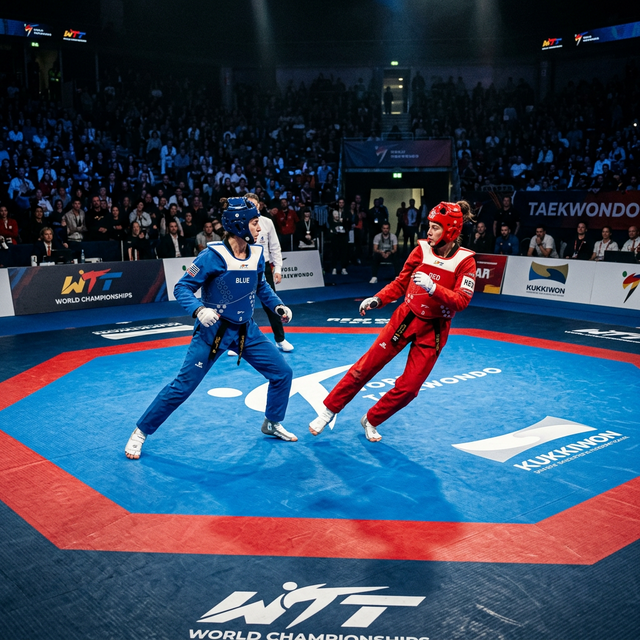
The Octagon Factor: Cutting Off the Angles
The introduction of the octagonal mat eliminated deep corners. In a square ring, a defensive fighter could easily be trapped in a 90-degree corner, severely limiting their lateral escape options. The octagon's 135-degree corners allow evasive fighters to continuously 'slide out' laterally along the boundary line without ever being truly cornered.
To combat this, offensive pressure-fighters cannot simply run forward in a straight line. They must "cut off" the ring. If the defensive fighter slides laterally to their right, the offensive fighter must step diagonally forward to intercept that path, pinning the evasive fighter closer to the boundary line, ultimately forcing a clash or a boundary penalty (Gam-jeom).
The 'Feint and Draw' Mechanism
The absolute pinnacle of distance management is forcing the opponent to attack air. By aggressively slide-stepping into the Red Zone (Zone 2) and immediately heavily retreating backward, you trigger the opponent's autonomic counter-attack reflex.
The opponent fires their heavy Kyorugi technique into empty space. In that precise millisecond of their recovery phase, the tactical fighter re-enters the zone and scores the undeniable point. This is effectively using distance as an offensive weapon—draining the opponent's stamina and confidence without making physical contact until the ultimate strike.
Conclusion
Great fighters possess great kicks. Champion fighters possess a great tape measure in their mind. Mastering the subtle half-steps, lateral slides, and aggressive distance closures is the mandatory prerequisite for surviving the modern Taekwondo circuit.
Access Restricted to Master Tier
Detailed tactical metrics and high-level strategy are reserved for Master-class members. Unlock the full database to continue.
Tactical Debrief
Share your operational insights